PET-CT Cancer Screening
Prefer to book it yourself? Call Chia-Yi Christian Hospital on 05-2765041 ext. 2792, 2750, 2751 or use its website ↗. It's free; most hospitals take bookings in Chinese.
We book it with the hospital for you, from US$149, paid only after the hospital confirms. We reply by email with available dates, the confirmed price, and whether an English report is available.
Paying from a US account? HSA and FSA notes.
A specialty-tier program with Abdominal ultrasound and a 27-test panel.
Every test, in English
27 tests listed, 27 of them on our shared test list, so they line up against other hospitals' packages.
Show all 27 tests and what each screens for
| Test | Screens for |
|---|---|
| Vitals | |
| Blood pressure | Screens for hypertension, a major risk factor for heart disease and stroke. |
| Height, weight and BMI | Basic body measurements used to assess weight-related health risk. |
| Basic vital signs (pulse, temperature, respiration) | Basic pulse, temperature and breathing rate measurements taken during a checkup. |
| Waist circumference | Central obesity, a marker of metabolic risk. |
| Blood Count | |
| Complete blood count | Anemia, infection and blood cell disorders. |
| Liver Function | |
| Albumin | Liver function and nutrition status. |
| ALT (SGPT) | Liver cell damage; the most common liver screening test. |
| AST (SGOT) | Liver cell damage. |
| Globulin and A/G ratio | Immune protein levels. |
| Total bilirubin | Jaundice, liver and bile problems. |
| Total protein | Nutrition and liver/kidney protein handling. |
| Kidney & Electrolytes | |
| Blood urea nitrogen | Kidney function. |
| Creatinine | Kidney function. |
| Uric acid | Gout risk and kidney stone risk. |
| Lipids & Cardiometabolic | |
| Total cholesterol | Cardiovascular risk. |
| Triglycerides | Cardiovascular and pancreatitis risk. |
| Glucose | |
| Fasting glucose | Diabetes and prediabetes. |
| Tumor Markers | |
| AFP | Liver cancer marker (also used with liver ultrasound in hepatitis B carriers). |
| CA-125 | Ovarian cancer marker. |
| CA 15-3 | Breast cancer marker. |
| CA 19-9 | Pancreatic and biliary cancer marker. |
| CEA | Colorectal and other GI cancer marker. |
| EBV VCA-IgA | Nasopharyngeal cancer risk (common in Taiwan and southern China). |
| PSA | Prostate cancer marker. |
| Urine & Stool | |
| Urinalysis | Kidney disease, urinary infection, diabetes. |
| Ultrasound | |
| Abdominal ultrasound | Liver (fatty liver, tumors), gallbladder stones, pancreas, spleen and kidneys. |
| Nuclear Medicine | |
| PET-CT (FDG) | Metabolically active tumors anywhere in the body. |
Before you book
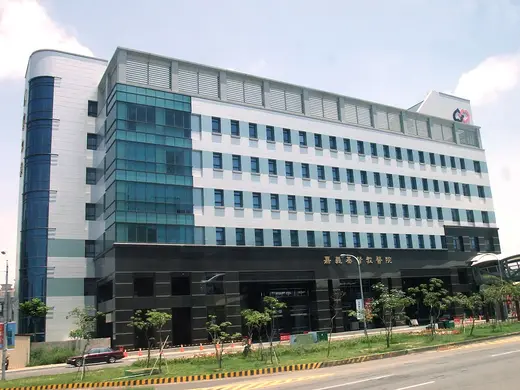
About 4 minutes' walk (294 m) from Jiabei station
On the OCAC i僑卡 partner list. Card holders can ask the center about a discount.
7 packages listed
About this hospitalAdd to this package
Tests this center prices separately that this package does not include.
| Test | Price | Note |
|---|---|---|
| Body composition analysisas listed: Body composition analysis (body fat %, BMI, ideal body weight, fat mass, basal metabolic rate) | US$31 NT$1,000 | |
| Vitamin D (25-OH)as listed: Vitamin D test | US$22 NT$700 | |
| Arterial stiffness (ABI / PWV)as listed: Arterial stiffness test (non-invasive ABI / baPWV device) | US$25 NT$800 | |
| Echocardiogramas listed: Cardiac ultrasound (echocardiogram) | US$125 NT$4,015 | |
| Spine X-rayas listed: Cervical spine X-ray (front and side views) | US$17 NT$540 | |
| Thyroid ultrasound | US$34 NT$1,100 | |
| Carotid ultrasound | US$64 NT$2,040 | |
| Breast ultrasoundas listed: Automated whole-breast ultrasound scan | US$114 NT$3,650 | For women |
| Low-dose chest CT | US$187 NT$6,000 | |
| Mammographyas listed: 3D mammography | US$72 NT$2,300 | For women |
Source ↗ · checked 2026-09-20
Bought one by one at US cash-pay marketplaces, the tests we could price list at about US$3,558–3,949 for a woman (25 of 26 tests) and US$3,517–3,918 for a man (24 of 25 tests) (MDsave, Quest and others; checked 2026-10-11).
How we priced it
A panel counts once however many of its tests the package lists. A test for one sex only is counted only for that sex. Tests we could not price are left out, so this is not what a US checkup would cost. Prices marked "rough" come from a single reseller or are extrapolated from a similar test.
- Abdominal ultrasound: US$150–375, MDsave, ultrasound one body area
- AFP: US$50, shayahealth.com (reseller), rough
- CA-125 (women only): US$34, shayahealth.com (reseller), rough
- CA 15-3 (women only): US$59, Walk-In Lab (reseller), rough
- CA 19-9: US$43, shayahealth.com (reseller), rough
- Complete blood count: US$29, Quest direct
- CEA: US$28, shayahealth.com (reseller), rough
- Creatinine and 8 related tests, priced as one panel: US$49, Quest direct comprehensive metabolic panel
- PET-CT (FDG): US$2,725, MDsave PET Scan
- Physician physical examination and 4 related tests, priced as one panel: US$250–400, CVS ($99-150); CoveredUSA median ~$250; Sidecar ($353-502)
- PSA (men only): US$52–62, Quest direct-to-consumer
- Total cholesterol and 1 related test, priced as one panel: US$59, Quest direct lipid panel
- Uric acid: US$42–49, Quest $42 (gout uric acid test); Labcorp OnDemand $49; Walk-In Lab $29 reseller
- Urinalysis: US$40–49, Quest $40; Labcorp OnDemand $49; Walk-In Lab $29 reseller
Radiation from this package's imaging
About 23 mSv in total, a typical adult dose for these exams: roughly 7.7 years of natural background radiation (about 3 mSv a year, US average).
- PET-CT (FDG) · about 23 mSv
Typical doses from published references (RadiologyInfo.org ↗, Mettler et al. 2008 ↗); the actual dose depends on the scanner and protocol. Ask the center for its own figure.
What US screening guidelines say
The US Preventive Services Task Force is an independent US panel whose recommendations cover people without symptoms. Shown for comparison; it is not advice for you.
What US screening guidelines say about 8 of these tests
General preparation notes for 6 tests in this package
This is general information about how the exam is usually done, not medical advice for you or your family member. Requirements vary by center and by individual health history — always follow the center's own instructions and your own doctor's guidance, especially for any medicine change.
Fasting for 9 to 12 hours (no food or drink except plain water) is often requested, so the test is often done in the morning.
Mention when booking: Confirm with the center whether your test needs fasting; if you take insulin or other diabetes medicine, ask the prescribing doctor how to manage it while fasting.
Fasting for 9 to 12 hours (no food or drink except plain water) is often requested.
Mention when booking: Confirm with the center whether your test needs fasting; if you take insulin or other diabetes medicine, ask the prescribing doctor how to manage it while fasting.
Usually needs at least 8 hours without food or drink except water beforehand.
Mention when booking: If you take insulin or other diabetes medicine, ask the prescribing doctor how to manage it while fasting, and mention it to the center.
Usually needs a clean-catch (midstream) sample; some tests instead ask you to collect all urine passed over 24 hours.
Mention when booking: Ask which specific urine test your provider ordered, since collection instructions vary by test.
Usually needs about 6 hours without food beforehand; clear fluids other than milk or fizzy drinks are commonly still allowed. Loose, comfortable clothing is easiest.
Mention when booking: Mention if you have type 1 diabetes, so the center can offer an early appointment time.
Usually needs several hours without food and only water to drink beforehand, then 30 to 60 minutes resting quietly after the tracer injection. Leave jewelry, hairpins and other metal at home.
Mention when booking: Tell the center about diabetes (ask the prescribing doctor about timing diabetes medicine), any contrast or iodine allergy, kidney disease, and pregnancy or breastfeeding.
Afterwards: Drink plenty of water afterward to help clear the tracer; normal activities can usually resume right away.
How we collect and check these prices: see who we are and where the data comes from.
If this isn't quite right
Other packages at Chia-Yi Christian Hospital
| Package | Tests | Price |
|---|---|---|
| Thyroid Function Mini Checkup | 22 | US$62 NT$2,000 |
| Liver & Kidney Function Mini Checkup | 25 | US$78 NT$2,500 |
| Xiaozi (Budget) Checkup | 34 | US$78 NT$2,500 |
| Civil Servant Health Checkup ProgramCivil-servant | 41 | US$109 NT$3,500 |
| Vitality Checkup | 44 | US$140 NT$4,500 |
| Vigor Checkup | 74 | US$206 NT$6,600 |
All packages at Ditmanson Medical Foundation Chia-Yi Christian Hospital Health Management Center →
US$ at 32.1 TWD, 23 Sep 2026; you pay in NT$.
Browse: Cancer screening · All checkups in Chiayi · What a checkup costs in Taiwan