Cerebral Arteriosclerosis (Stroke) Program
Prefer to book it yourself? Call Taiwan Adventist Hospital on (02)2740-0729, (02)2751-2747, (02)2781-3394 or use its website ↗. It's free; most hospitals take bookings in Chinese.
We book it with the hospital for you, from US$149, paid only after the hospital confirms. We reply by email with available dates, the confirmed price, and whether an English report is available.
Paying from a US account? HSA and FSA notes.
A specialty-tier program with Exercise stress ECG and Resting ECG and a 37-test panel, with a doctor's review at the end.
What stands out
Reduced blood flow to the heart during exertion.
Heart rhythm and signs of prior heart damage.
Every test, in English
37 tests listed, 29 of them on our shared test list, so they line up against other hospitals' packages.
Show all 37 tests and what each screens for
| Test | Screens for |
|---|---|
| Vitals | |
| Blood pressure | Screens for hypertension, a major risk factor for heart disease and stroke. |
| Height, weight and BMI | Basic body measurements used to assess weight-related health risk. |
| Blood Count | |
| Complete blood count | Anemia, infection and blood cell disorders. |
| Vitamin B12 and folate | Deficiencies that cause anemia and nerve problems. |
| White blood cell differential | Breakdown of white cell types; infection, allergy and some blood cancers. |
| Liver Function | |
| Albumin | Liver function and nutrition status. |
| Alkaline phosphatase | Liver, bile duct and bone conditions. |
| ALT (SGPT) | Liver cell damage; the most common liver screening test. |
| AST (SGOT) | Liver cell damage. |
| Gamma-GT | Bile duct and alcohol-related liver stress. |
| Globulin and A/G ratio | Immune protein levels. |
| Total protein | Nutrition and liver/kidney protein handling. |
| Kidney & Electrolytes | |
| Creatinine | Kidney function. |
| Uric acid | Gout risk and kidney stone risk. |
| Lipids & Cardiometabolic | |
| HDL cholesterol | Protective cholesterol level. |
| Homocysteine | Cardiovascular risk marker. |
| LDL cholesterol | The main cholesterol driving heart disease risk. |
| Total cholesterol | Cardiovascular risk. |
| Triglycerides | Cardiovascular and pancreatitis risk. |
| Glucose | |
| Fasting glucose | Diabetes and prediabetes. |
| Hemoglobin A1c | Average blood sugar over the past three months; diabetes. |
| Cardiac | |
| Exercise stress ECG | Reduced blood flow to the heart during exertion. |
| Resting ECG | Heart rhythm and signs of prior heart damage. |
| X-ray | |
| Chest X-ray | Lung, heart size and chest abnormalities. |
| Eye | |
| Color vision | Color vision deficiency. |
| Retinal (fundus) photography | Diabetic and hypertensive eye damage, macular degeneration. |
| Intraocular pressure | Glaucoma. |
| Visual acuity | Vision sharpness. |
| Consultation | |
| Physician physical examination | A doctor's hands-on examination and history taking. |
Before you book
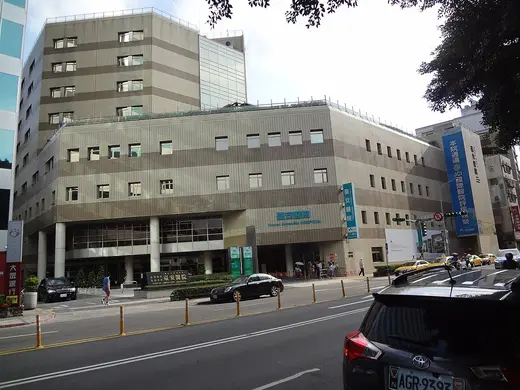
About 7 minutes' walk (545 m) from Nanjing Fuxing station
On the OCAC i僑卡 partner list. Card holders can ask the center about a discount.
17 packages listed
About this hospitalWhat the center says
From the center's own pages, in English. Each statement links to its source.
The health management center's checkup hours are Monday to Friday, mornings 8:00-11:00 and afternoons 1:00-4:00.
The center asks patients to fast starting after dinner the night before, until the exam is finished.
For the sigmoidoscopy fast, the center says patients should keep taking prescribed medication as usual, except that diabetic patients should stop their blood-sugar-lowering medication during the fasting period to avoid an accident, and bring the medication along to take after the exam.
The center's preparation instructions ask patients to fast from midnight the night before the exam, until it is finished.
Ask your own doctor before changing any medicine.
For the Stroke Risk (Cerebral Artery Hardening) package, the report is explained at a follow-up clinic visit booked on Monday, Tuesday or Thursday afternoons.
The hospital charges NT$200 to burn a CD of a general X-ray (X-RAY) exam's images, usually ready in 30 to 60 minutes; the disc does not support Apple's operating system, and the center only burns its own hospital's images, not other hospitals'.
Bought one by one at US cash-pay marketplaces, the 29 of 29 tests we could price list at about US$1,471–1,794 (MDsave, Quest and others; checked 2026-10-11).
How we priced it
A panel counts once however many of its tests the package lists. A test for one sex only is counted only for that sex. Tests we could not price are left out, so this is not what a US checkup would cost.
- Complete blood count and 1 related test, priced as one panel: US$29, Quest direct
- Chest X-ray: US$100–150, careroute.ai; khealth.com
- Creatinine and 7 related tests, priced as one panel: US$49, Quest direct comprehensive metabolic panel
- Exercise stress ECG: US$490, MDsave Stress Test (treadmill EKG)
- Retinal (fundus) photography: US$25–50, Optos optomap billing FAQ ($39-65); Lifetime Eye Care ($29); Vision Plus ($30); Luck Optical ($15); CoveredUSA ($20-50)
- Gamma-GT: US$29–59, Labcorp OnDemand GGT $59; Walk-In Lab $29 (reseller, plus $6 physician fee)
- Hemoglobin A1c: US$39, Quest direct
- Homocysteine: US$75–79, Quest $75; Labcorp OnDemand $79; Walk-In Lab $69 reseller
- Physician physical examination and 2 related tests, priced as one panel: US$250–400, CVS ($99-150); CoveredUSA median ~$250; Sidecar ($353-502)
- Resting ECG: US$102, CarePriceGuide national average
- Total cholesterol and 3 related tests, priced as one panel: US$59, Quest direct lipid panel
- Uric acid: US$42–49, Quest $42 (gout uric acid test); Labcorp OnDemand $49; Walk-In Lab $29 reseller
- General eye exam and 3 related tests, priced as one panel: US$100–150, Warby Parker ($85); America's Best ($80); CoveredUSA median ~$150; VisionTestCost 1280-store median $95
- Vitamin B12 and folate: US$82–89, Quest $82; Labcorp OnDemand $89; Walk-In Lab $59 reseller
Radiation from this package's imaging
About 0.1 mSv from the tests we could identify, a typical adult dose for these exams: less than 1 month of natural background radiation (about 3 mSv a year, US average).
Not counted: Brain and cerebral vessel MRI/MRA (without contrast). If it is an X-ray, CT or PET scan, the total is higher.
- Chest X-ray · about 0.1 mSv
Typical doses from published references (RadiologyInfo.org ↗, Mettler et al. 2008 ↗); the actual dose depends on the scanner and protocol. Ask the center for its own figure.
What US screening guidelines say
The US Preventive Services Task Force is an independent US panel whose recommendations cover people without symptoms. Shown for comparison; it is not advice for you.
What US screening guidelines say about 11 of these tests
General preparation notes for 6 tests in this package
This is general information about how the exam is usually done, not medical advice for you or your family member. Requirements vary by center and by individual health history — always follow the center's own instructions and your own doctor's guidance, especially for any medicine change.
Fasting for 9 to 12 hours (no food or drink except plain water) is often requested, so the test is often done in the morning.
Mention when booking: Confirm with the center whether your test needs fasting; if you take insulin or other diabetes medicine, ask the prescribing doctor how to manage it while fasting.
Fasting for 9 to 12 hours (no food or drink except plain water) is often requested.
Mention when booking: Confirm with the center whether your test needs fasting; if you take insulin or other diabetes medicine, ask the prescribing doctor how to manage it while fasting.
Usually needs at least 8 hours without food or drink except water beforehand.
Mention when booking: If you take insulin or other diabetes medicine, ask the prescribing doctor how to manage it while fasting, and mention it to the center.
Usually needs a few hours without food, and no caffeine for longer beforehand; wear comfortable clothing and walking or running shoes.
Mention when booking: Ask the prescribing doctor before changing any heart medicine before the test; mention asthma and bring an inhaler if you use one.
Afterwards: You are usually monitored for 10 to 15 minutes afterward until your heart rate returns to normal.
Usually needs no fasting; you remove jewelry, metal objects and sometimes clothing above the waist for a hospital gown.
Mention when booking: Tell the center if you are, or might be, pregnant.
Often done with a camera that photographs the retina without drops; some centers use dilating drops that widen the pupil, which blurs vision for a few hours afterward.
Mention when booking: Mention any eye pain, halos around lights, or a narrow drainage angle or angle-closure glaucoma history.
Afterwards: If drops were used, vision may be blurry and light-sensitive for a few hours; have someone else drive. Sudden eye pain, headache, blurred vision or halos after dilation need urgent care.
How we collect and check these prices: see who we are and where the data comes from.
If this isn't quite right
Other packages at Taiwan Adventist Hospital
| Package | Tests | Price |
|---|---|---|
| 'A-Faith' Checkup | 38 | US$150 NT$4,800 |
| Precious Lady Checkup | 36 | US$249 NT$8,000 |
| 'B-Hope' Checkup | 41 | US$305 NT$9,800 |
| 'C-Love' Checkup | 46 | US$305 NT$9,800 |
| Cardiovascular Disease Screening | 27 | US$312 NT$10,000 |
| Men's Program | 43 | US$312 NT$10,000 |
| Half-Day Joyful Gentleman Type Checkup | 50 | US$492 NT$15,800 |
| Half-Day Grateful Lady Type Checkup | 54 | US$517 NT$16,600 |
| Painless Gastroscopy and Colonoscopy Examination | 42 | US$555 NT$17,800 |
| Cardiopulmonary Strengthening Program | 41 | US$561 NT$18,000 |
All packages at Taiwan Adventist Hospital Health Management Center →
Similar packages in Taipei
| Package | Hospital | Tests | Price |
|---|---|---|---|
| Ultimate Lab Testing Package H | Cheng Hsin General Hospital Health Management Center | 65 | US$498 NT$16,000 +20% without Taiwan ID or NHI card |
| Standard Painless GI Endoscopy Package | Chang Gung Memorial Hospital Taipei Health Examination Center | 71 | US$763 NT$24,500 Women US$841 |
US$ at 32.1 TWD, 23 Sep 2026; you pay in NT$.
Browse: Brain · Heart and blood vessels · All checkups in Taipei · What a checkup costs in Taiwan